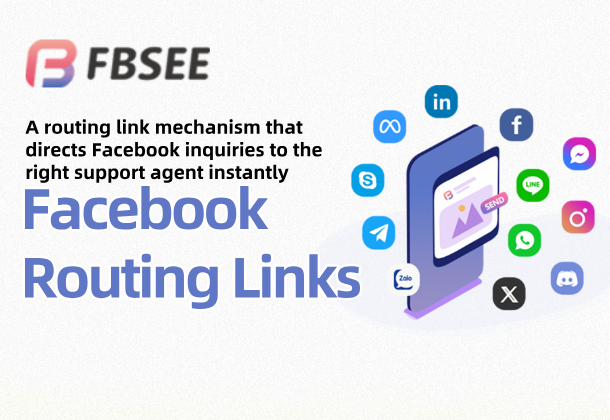
Too Many Facebook Customer Service Accounts and Staff?
How to Direct Inquiries to the Right Customer Service Representatives via Split Links
👉fbsee diversion link/counting/following/accepting fans/multiple chats/AI account management/translation/intelligent customer service software: https://fbsee.com/en
😊For free trial, please contact TELEGRAM✈ official customer service: @Fbsee
When using Facebook for cross-border business advertising, the most common problem isn't "no inquiries," but rather "all inquiries concentrated on the same account or the same person."
As advertising costs increase and the volume of inquiries grows, teams are prone to the following situations:
* Three people replying to the same private message simultaneously
* A flood of comments, with no one sure who should handle it
* Multiple customer service representatives handling the same customer simultaneously
* Some messages go unanswered and accumulate
* Overseas customers are lost due to long waiting times
The core of these problems points to—the team lacks a mechanism to automatically "assign customers to the right customer service representative."
"Split links" are designed to solve this critical scenario that has long plagued cross-border teams.
I. Why is "Distribution Chaos" Most Prone to onboarding in Facebook customer service?
Facebook's structure inherently makes customer service work prone to chaos.
1. Too Many Entry Points, Inability to Manage Manually
* Comments, private messages, advertising messages, fan page comments, short video comments, feed responses…* Each of these can be an entry point for customer inquiries.
1. Without traffic redirection, all customer service representatives are focused on the same backend, making task allocation difficult.
2. With increased advertising budgets, message volume multiplies.
More ads mean more inquiries, but not every customer service representative can keep up.
Manual allocation is simply not fast enough.
3. Multiple accounts running concurrently, customers don't know who to contact.
Some add page information, some contact personal accounts, and some click on ads and leave notes.
Message sources are scattered, making automatic allocation impossible for the team.
4. Global customers are in different time zones, making manual scheduling almost impossible to cover.
Southeast Asia sees peak inquiries at night, while the US experiences peak inquiries during the day, both in different time zones.
Manual allocation is almost impossible to provide 24/7 timely service.
All of these factors lead to one result—the busier it is, the more chaotic things become, and the more chaotic things are, the easier it is to miss customers.
II. What is a redirection link? Why is it particularly crucial for Facebook customer service?
A redirection link is a function that "automatically redirects to a specific customer service representative upon clicking."
Its core value is: to unify the entry point for all customers and then automatically allocate them according to rules.
Regardless of whether customers find the entry point through the ad page, Facebook page, post comments, short videos, or private messages, clicking the link will redirect them to the following options according to system settings: Available Customer Service Representative, Specific Department, Specific Language Customer Service Representative, Specific Region Customer Service Representative, or the next customer service representative in the polling mechanism. This eliminates the need for manual task assignment within the team.
III. How do referral links improve the overall operation of Facebook customer service?
The following are the most typical application scenarios for cross-border teams.
1. Automatic redirection of ad inquiries to the corresponding salesperson: Different ads targeting different products and regions require different customer service representatives.
Manual management is simply impractical.
Referral links allow customers from different ads to be automatically redirected to the corresponding customer service representative.
2. Automatic assignment of multilingual customer service representatives: Customers from Vietnam, the Philippines, and Thailand are mixed?
Different language entry points can redirect to different customer service representatives.
Reduce misunderstandings and increase conversion rates.
3. Multiple accounts used in the same scenario to solve the problem of overlapping orders: One ad may generate a large number of inquiries. The system can ensure that each click is evenly rotated to a different customer service representative.
Prevent multiple people from competing for the same customer.
4. Smooth Operations During Major Sales Events, Holidays, and Peak Marketing Periods
During major sales events such as Black Friday, Christmas, and Ramadan, inquiries surge.
Distributed links prevent customers from crowding into a single entry point, instead distributing them across the entire team.
IV. What Can FBSee's Distributed Links Achieve in Practice?
FBSee's distributed links are not simply "redirects," but are deeply optimized for real-world cross-border customer service scenarios.
1. One Link Supports Multiple Platform Redirects
The same distributed link can redirect to:
Facebook Messenger
Instagram DM
Telegram
Line
Zalo
Customers from different platforms can still be uniformly distributed.
2. Supports Rotation, Fixed, Random, and Departmental Distribution
Teams can choose the distribution mode according to their needs:
Rotation: Suitable for even distribution within the team
Random: Suitable for scenarios with a large number of inquiries due to advertising
Fixed: Suitable for after-sales, complaints, and VIP customers
Departmental: Suitable for teams with multiple product lines and regions
Closer to real-world business.
3. Automatic Customer Assignment to a Unified Backend
Customer service representatives don't need to switch to external platforms; all incoming messages can be handled within the Facebook See backend.
This reduces missed messages, delays, and internal clutter.
4. Integration with a Follower Counter and Ticket System
Traffic Sharing Link → Customer Inbound → Automatically Enters Counter → Ticket Distribution
The entire process is automated, requiring no manual intervention.
5. Significantly Reduces "Duplicate Orders and Duplicate Responses"
Every customer is uniquely assigned to a single customer service representative.
There are no multiple people competing for customers, and no one is left unattended.
V. Traffic Sharing Links are the Core of the Facebook Customer Service System, Not an Optional Feature
To ensure the stability of the Facebook customer service system under high concurrency, businesses must have:
A clearly defined entry point
A clear assignment logic
A unified backend
A visualized customer service process
Automation mechanisms
Traffic sharing links are the core starting point of this entire system.
The earlier you configure them, the sooner you can escape chaos and improve conversion rates.